
My role: Social media strategy, content architecture, science translation, platform management and analytics
Focus: Public education, ocean literacy, audience growth and credibility building
Status: On-going
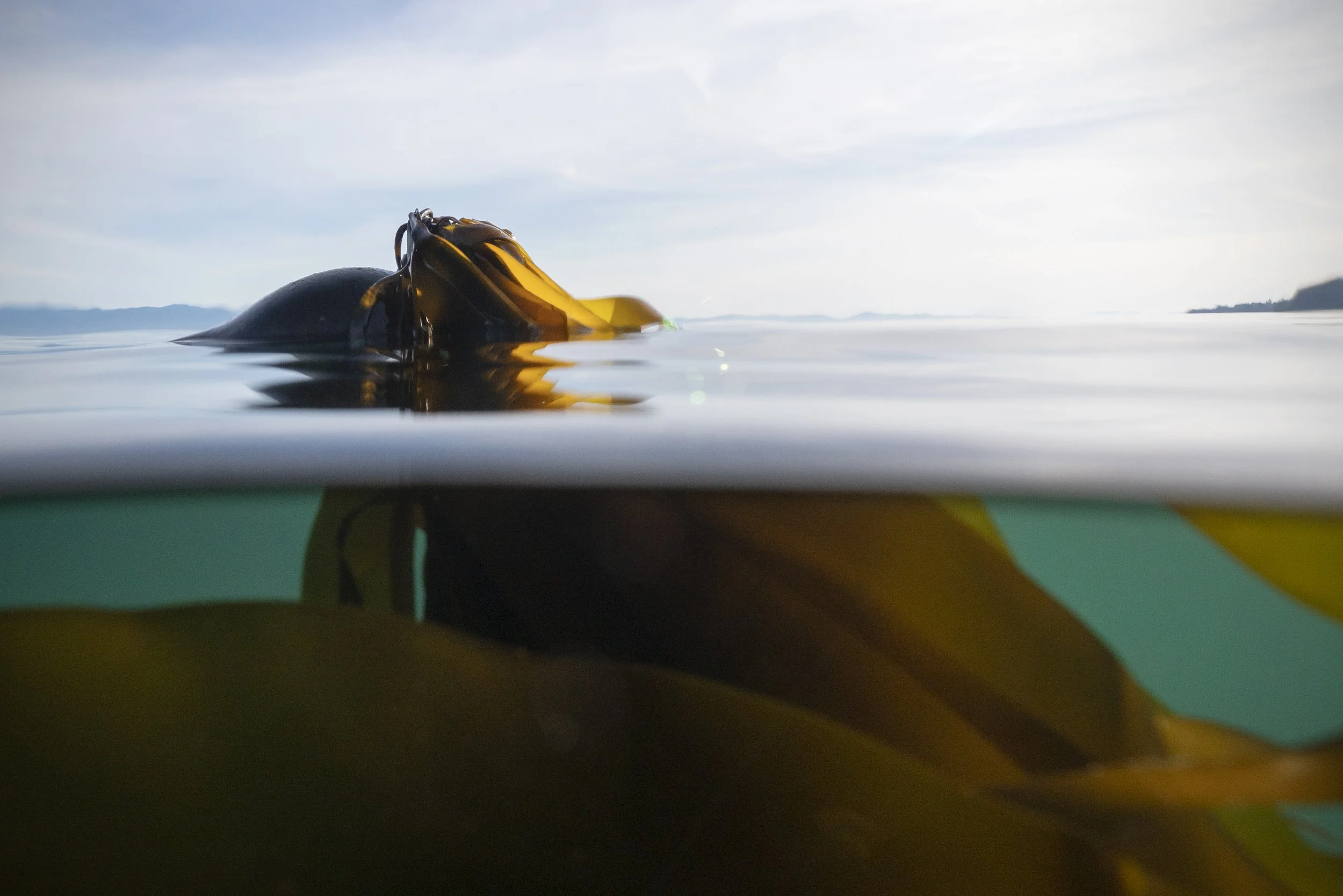
PHOTO: NIKKEY DAWN
When I took on social media strategy and management for The Kelp Rescue Initiative, I focused on building a public-facing system that could carry complex science, long-term restoration timelines and sensitive partnerships in a way that people could understand, trust and engage with.
Kelp forests are declining across much of the BC coast, yet public understanding of these ecosystems and their role in climate resilience, biodiversity and coastal protection remains limited. One of the biggest challenges facing underwater restoration projects is visibility. Because these ecosystems exist largely out of sight for most people, the threats they face and the importance of protecting them often go unseen as well.
This case study outlines how I designed and implemented a social media strategy that centres public education, improves ocean literacy and builds a credible, engaged audience around kelp restoration.
The challenge
The Kelp Rescue Initiative was working to communicate complex, place-based marine science in a digital space where most people will never experience kelp forests firsthand. For many audiences, kelp forests are invisible ecosystems. They are underwater, unfamiliar and easy to overlook.
The challenge was not only public education, but building awareness of the organization itself, establishing credibility and trust and clearly answering two foundational questions for new audiences.
Who are we?
Why do kelp forests matter?
At the same time, the social media accounts needed structural optimization. Bios, highlights, pinned posts and visual consistency were not yet doing the work of orienting first-time visitors or clearly communicating the organization’s purpose within seconds, a critical factor for growth on social platforms.
My approach
1. CREATING A CLEAR, TRUST-BUILDING FOUNDATION
The strategy was shaped around distinct audiences, including ocean-minded community members, students, researchers, collaborators and funders. Each audience influenced tone, depth and platform choice.
Instagram was used to prioritize visual learning, accessibility and emotional connection
LinkedIn supported credibility, transparency and collaboration with partners and funders
BlueSky enabled informal science conversation, peer amplification and knowledge sharing
Defining audiences first ensured content remained accurate and engaging without becoming either overly technical or overly simplified.
At the same time, I optimized the accounts themselves. Bios, highlights and pinned posts were refined so that first-time visitors could immediately understand who the organization is, why kelp forests matter and how the science connects to broader ecological and social systems.
2. CREATING CONTENT PILLARS TO SUPPORT CONSISTENCY AND DEPTH
To support long-term clarity and sustainability, I developed five content pillars that guide all planning and execution.
Kelp science and credibility
Indigenous partnerships and amplifying traditional knowledge and stewardship
Connection and public engagement
Climate and resilience
Collaboration and transparency
These pillars ensure that public understanding of kelp forests is reinforced from multiple angles, while keeping the overall narrative cohesive and aligned with the organization’s values and research priorities.
3. MAKING A MARINE ECOSYSTEM RELATABLE
A core challenge was helping audiences connect to an ecosystem they may never experience in real life. Content focused on translating ecosystem services into concepts people already care about.
Posts highlighted how kelp forests support fisheries and food webs, protect shorelines from erosion, sequester carbon and create resilience in changing oceans. Visual storytelling, simple metaphors and plain language explanations helped make underwater processes tangible and relevant.
4. CREATING ENGAGEMENT
While education was a key feature, the strategy was not built around education alone. On social platforms, people are looking to be interested, entertained and emotionally engaged.
I developed content that balanced science-backed information with visual curiosity, discovery and moments of wonder. Short-form video and striking underwater imagery helped draw people in, while captions made the science accessible. This allowed learning to happen organically, without feeling instructional or overwhelming.
5. BUILDING FOR SCALE
The strategy was designed as a working system rather than a static document. Clear guidelines, templates and decision logic allow others to contribute without losing voice, values or scientific accuracy.
This approach is especially important for science-based organizations, where capacity often shifts due to funding cycles and contract-based work. Building for continuity ensures public communication remains consistent and trustworthy over time.
Implementation and results
AUDIENCE GROWTH AND ENGAGEMENT
Since implementing this strategy seven months ago, the Instagram account has doubled in followers.
More importantly, engagement has remained consistently strong.
Across recent months:
Average engagement rates have hovered around 9%, well above common nonprofit benchmarks of 2–5%
Science and research accounts often see 1–3% engagement, making these results notably strong for a technical subject area
Analytics show that monthly reach has consistently exceeded follower count, with a significant portion of views coming from non-followers, indicating that content is reaching well beyond the existing audience
This shows the content is not only being seen, but actively interacted with.
What performs best
Patterns in the analytics consistently show that:
Behind-the-scenes science content performs strongly, especially when it reveals process rather than outcomes
Visual explanations of kelp ecology and restoration generate saves and shares
Interactive educational content encourages participation without overwhelming the audience
This reinforces the value of transparency and education-driven storytelling.
What this work demonstrates
This case study shows how social media can function as a serious extension of science communication.
Rather than focusing on trends or volume, the strategy prioritizes:
Accuracy over simplification
Education over virality
Trust over reach alone
Long-term narrative building over one-off posts
The result is a social presence that supports public understanding of kelp decline and restoration, while also signalling professionalism and credibility to collaborators and funders.
Why this approach matters
Public support for restoration does not come from knowing everything. It comes from understanding enough to care and feeling invited into the solution.
By grounding social media in the research and science, place and transparency, this work helps people grasp why kelp forests matter, what is at stake in their decline and how recovery is possible. At the same time, it creates a clear, repeatable model for how complex environmental science can be communicated ethically and effectively.